
METRO: Nuclear Plant Licensing Platform
Dual-portal B2B SaaS platform that turns years of paper-based regulatory chaos into a structured, role-based digital workflow.
Web Portal . Admin Platform
Designing a data-driven platform to streamline multi-year nuclear licensing workflows
Reduced complexity of regulatory processes spanning thousands of requirements, multi-role collaboration, and long-term document management.
“Facilitated back end database migration for Web and Mobile apps to Flutter flow, unifying the digital assets for the platforms
My Role
Responsibilities
Team
Platform
UX Designer
UX strategy, research, interaction design, accessibility,handoff
UI Designer, Design Lead, PO, BA
Admin Portal, Organization Platform-Multiple Users

The Problem
Nuclear plant licensing is one of the most document-heavy, multi-year processes in regulated industry. Organizations were managing hundreds of compliance requirements across 20-person teams with no shared system, losing institutional knowledge every time an employee left.
The Solution
A dual-portal B2B SaaS platform - METRO - that digitizes the entire licensing workflow. NPX sets master templates; organizations extend them, assign requirements to the right people across finance, operations, and legal, and track progress across every plant they build.
The Outcome
A fully tested prototype covering 5 end-to-end user scenarios, delivered with a complete design system and role-based access model.
The client returned for a Phase 2 iteration - a direct measure of confidence in the work.
- The Problem -
Nuclear licensing is not a form you fill out.
“Multiple years of work. Hundreds of requirements. No system to manage it.”
Nuclear power companies spend years compiling licensing applications made up of hundreds of regulatory requirements, documents, and approvals. The process spans across teams, tools, and timelines- often resulting in fragmented data, lost documentation, and inconsistent submissions.
Despite the scale and repetition, every new plant starts almost from scratch.
1
Documentation Chaos
Difficulty in maintaining documentation and tasks required for Nuclear power plant licensing process
2
Multi-Year Drag
Long regulatory process to go through to build a new power plants that hinders the process to file the application.
3
Geographic Variation
Requirements differ across Canadian provinces. A project in Alberta is not the same as one in Ontario. Every new plant starts from scratch - every time.
"It's not just applying for a license. It's something that will store your data and your package for the longest of time."
-Direct from discovery session with NPX stakeholder
- Research/ Discovery -
Discovery before wireframes.
I led structured discovery workshops with the NPX leadership team before touching a single screen. The goal was to understand how nuclear organizations actually work - who does what, in what order, and where the process breaks down. This phase directly shaped the MVP scope and what we chose not to build.
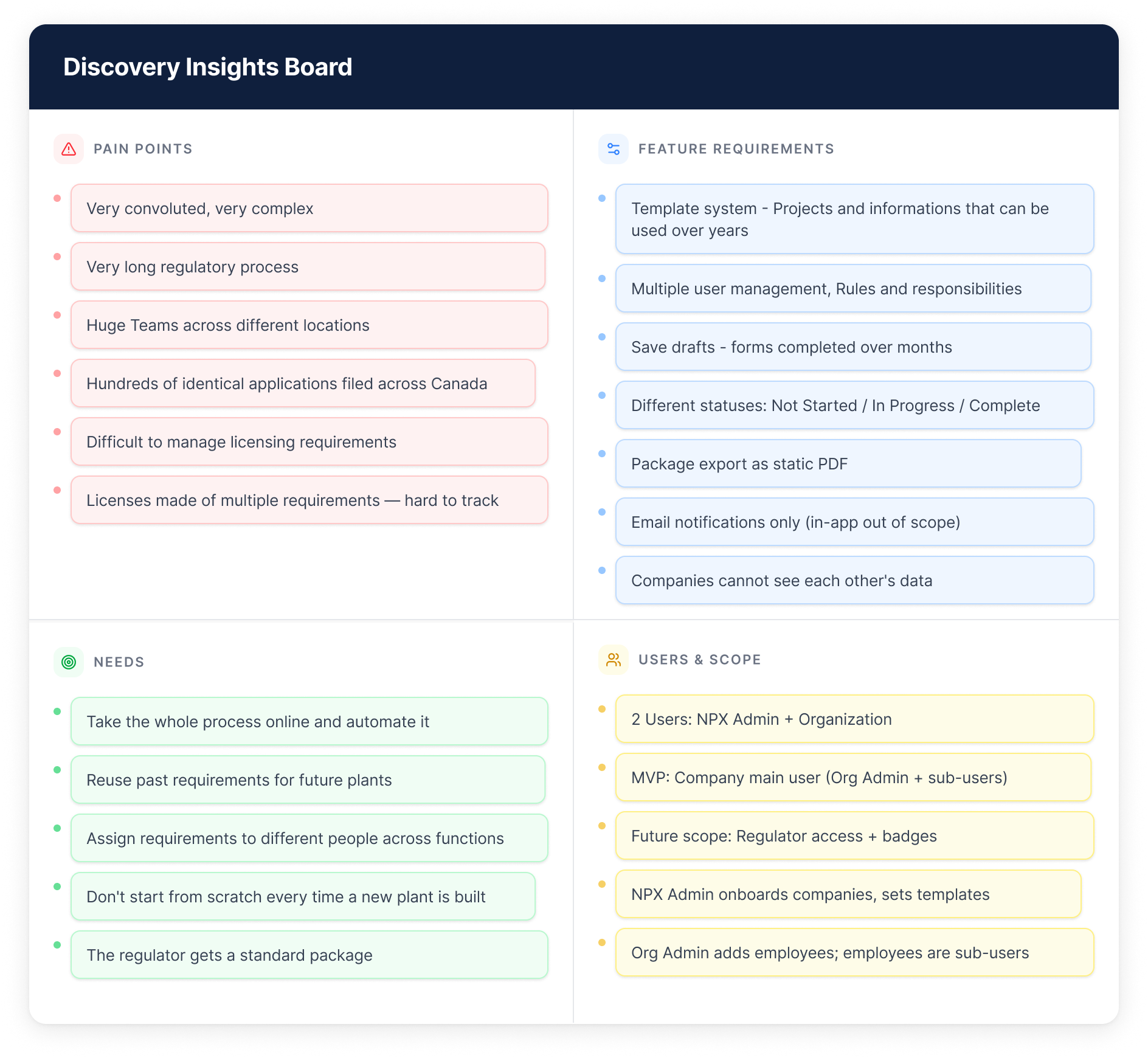
Three strategic decisions made in research that changed the product
Scoped Regulator to Phase 2,
Chose email-only notifications
Defined "requirement" vs. "task" as distinct data objects - a distinction the client had not yet articulated.
“Requirements come from regulatory documents. Tasks are what your team does to meet them. That distinction changed everything."
- Key Insight -
The platform is not a form tool. It is an institutional memory system.
- The Reframe -
"Don't make new plants spend 2 to 3 years gathering requirements, and information from scratch every time. They should be able to use & reuse information that are standard across provinces and things they have gathered before."
This reframe drove four foundational design decisions:
NPX owns master templates, but organizations are free to customize them to fit their own plant, province, and team.
A 4-tier role hierarchy supports delegation at scale.
Every requirement holds a persistent status so teams can resume work months later without losing context.
Strict approval/ rejection step before submission, to adhere to regulatory standard.
Freedom without oversight is its own risk in a regulated industry, so customization runs through an approval and rejection flow. A manager up the chain reviews any change an organization makes to a template or requirement before it is considered final - giving organizations room to adapt the platform to how they actually work, without NPX losing control of what ends up in a regulatory package.
Persistent statuses across months ✅
Approval / rejection workflow ✅
4-tier role hierarchy ✅
Reusable documentation from past projects ✅
Template-first architecture ✅
Customizable templates ✅

-Information Architecture-
Structure before screens.
Mapping the IA first caught a problem the brief had not flagged: the original concept conflated Organization Admin and Project Owner permissions. Separating them in the IA before wireframing saved significant rework later.
Metro Admin Platform
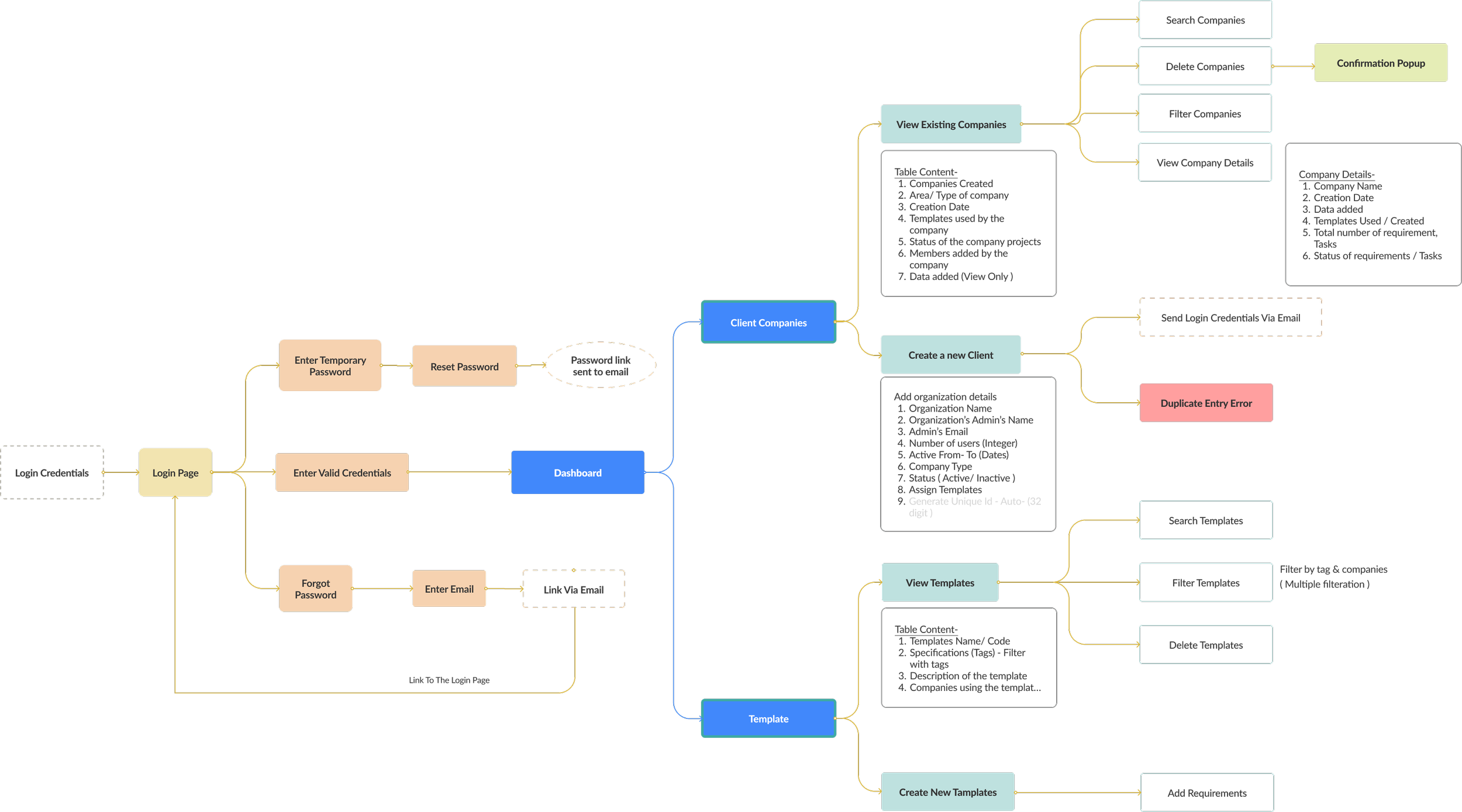
"Every screen you see is the result of knowing exactly who is allowed to see it."
-Enterprise Dashboard Design-
Complex data, made scannable.
METRO serves two fundamentally different users who need fundamentally different things from the same data.
That gap drove every dashboard decision -
And underneath the dashboards, a set of complex forms and filtration flows had to make hard workflows feel manageable.
What to surface?
How to measure it?
What to leave out?
01-Dashboards
Two portals. Two jobs. Two visual languages.
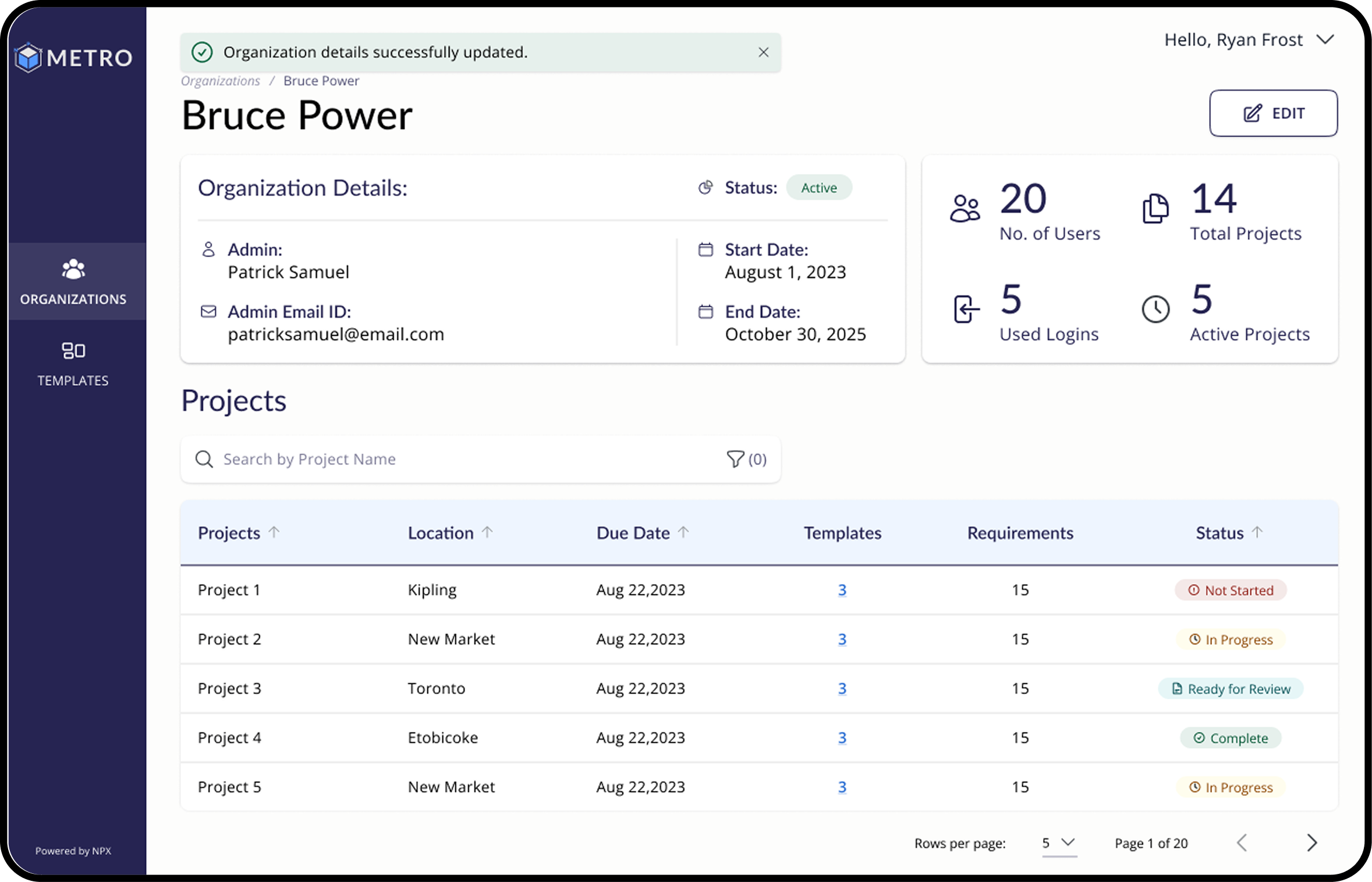
Metro Admin Dashboard: Company Management
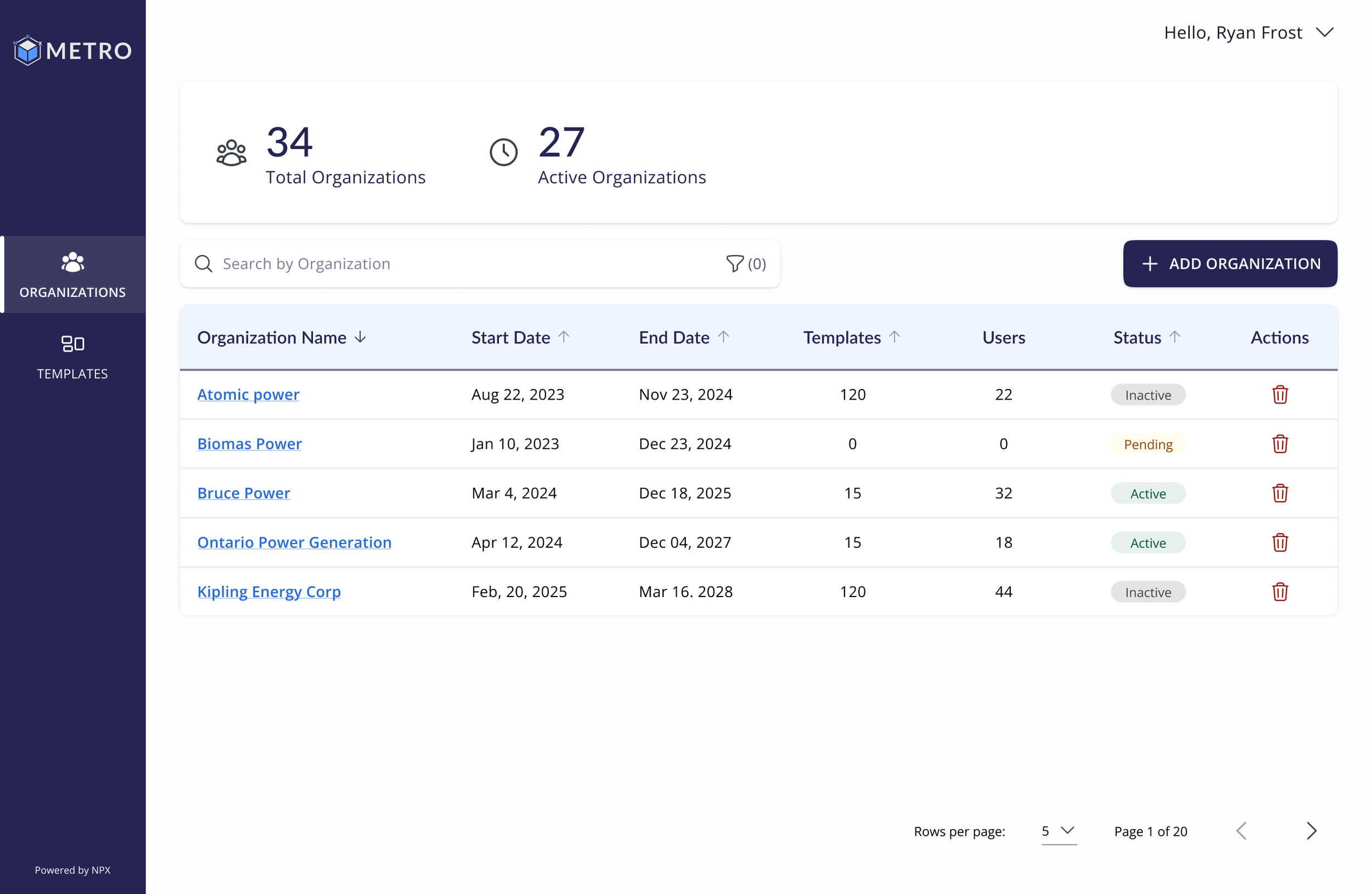
The Metro Admin dashboard is a management ledger - total organizations, active clients, contract timelines. Numbers and lists, because the job is oversight at scale.
Organization Project Status: Project Health
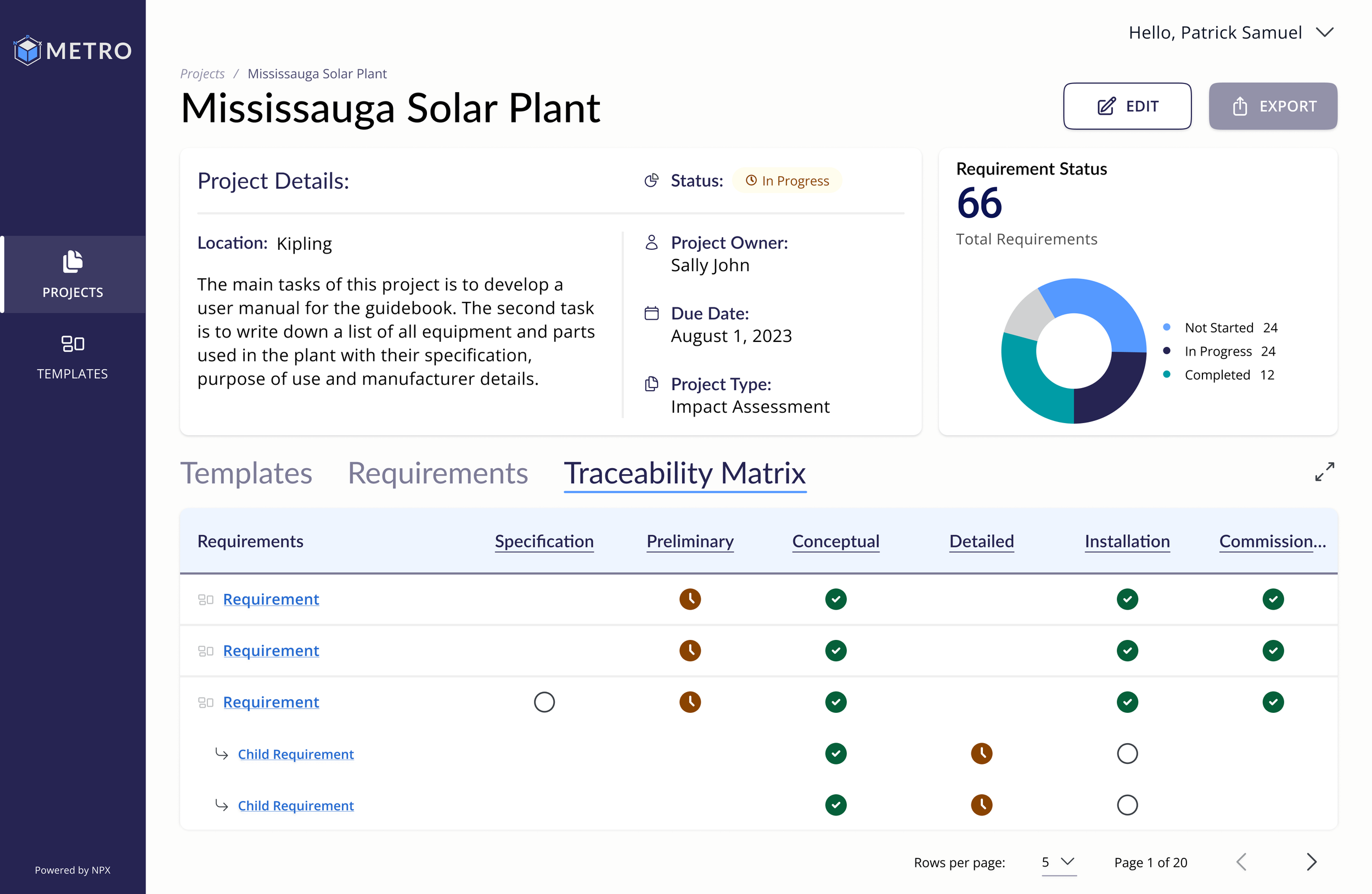
The Organization dashboard is a health report - project completion rings, requirement status breakdowns, overdue flags rendered as visual diagrams so project head can read the state of a multi-year project at a glance.
Same platform, different mental models, because the job to be done is fundamentally different. One is managing a portfolio. The other is shipping a regulatory package.
02 — Forms & Complex Workflows
Multi-axis filtering. Step-by-step creation.
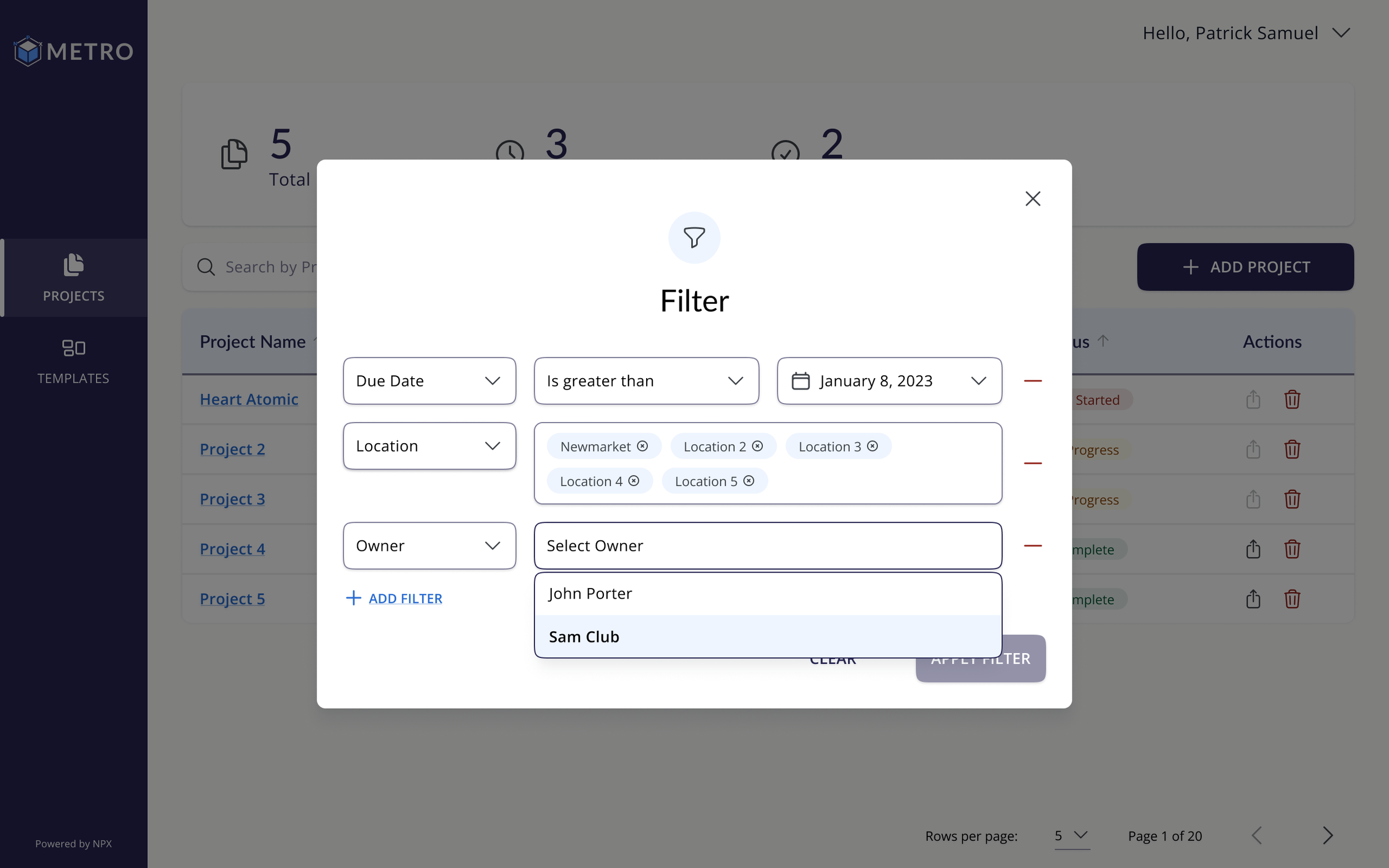
Table Search Functionality: Stackable Filter
Form Table: Creating/ Editing Requirement
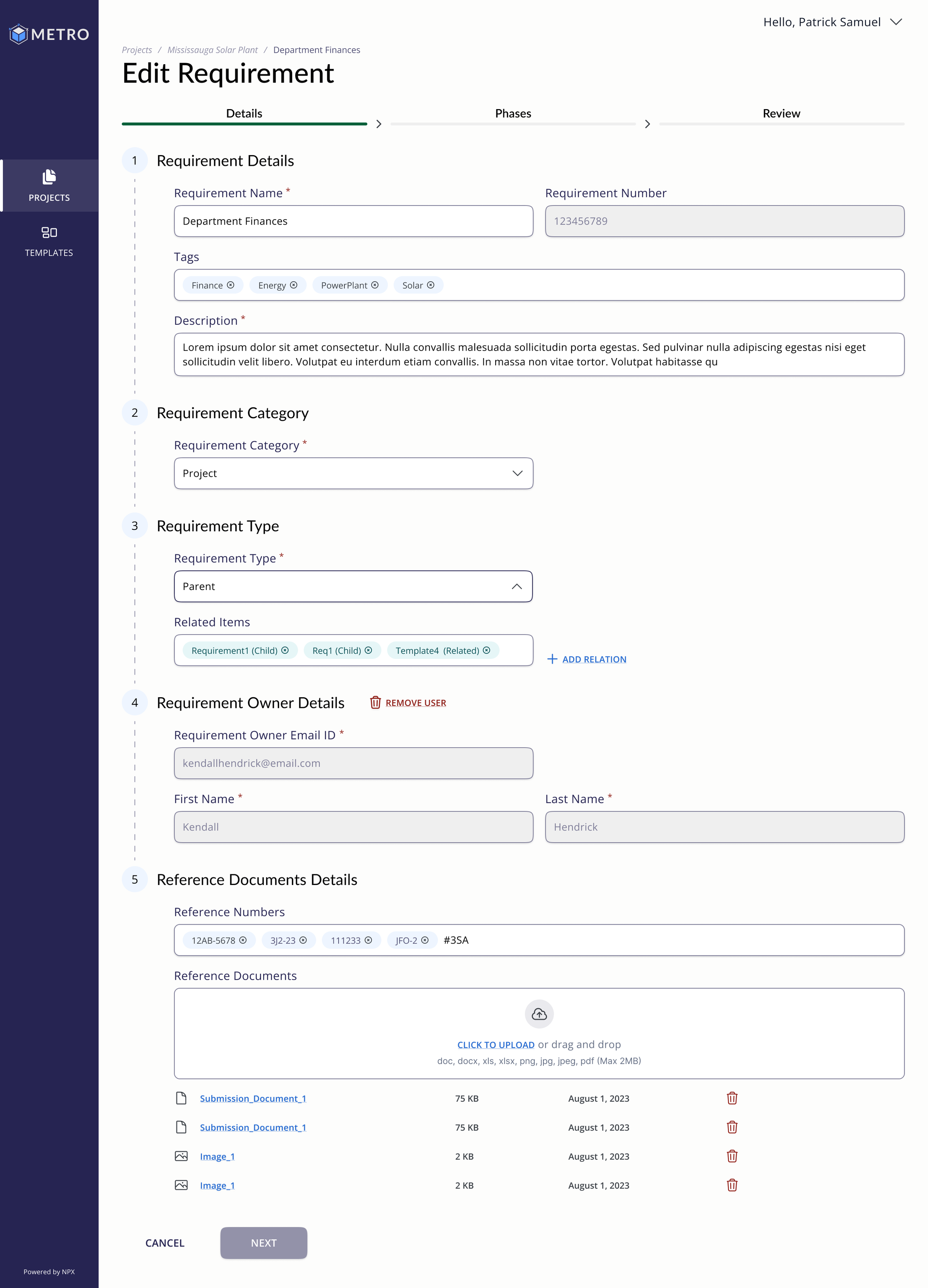
To prevent form fatigue with dense compliance data, we rejected a single-page layout in favor of a 3-step progressive wizard (Details → Phases → Review).
The visual stepper provides an immediate chronological roadmap, reducing cognitive load and setting clear expectations while ensuring critical inline tasks-like document uploads, are completed before advancing.
Why this approach wins
Combating Form Fatigue: Breaking down massive, text-heavy data inputs into distinct logical chunks keeps the user focused and reduces completion anxiety.
Inline Task Accountability: Forcing uploads and section validation to happen sequentially ensures users don't accidentally skip crucial steps, which is vital for highly regulated nuclear tracking software.
The "Review" Safety Net: Dedicating a final, explicit step for reviewing all input data acts as a final QA checkpoint, significantly reducing human error before the data hits the live dashboard database.
Standard global searches fail under the weight of multi-year nuclear data. We rejected a flat search model for a stacked, cascading system with multi-select capabilities for Location, Owner, and Status.
This allows users to dynamically isolate complex cross-provincial datasets simultaneously, without triggering dead ends or 'no results found' errors.
Why this approach wins
Combating the "Zero-Result" Trap: Standard keyword searches or flat multi-selects often lead to dead-ends. A stacked dependency dynamically updates options, so selecting multiple locations only surfaces owners relevant to those specific regions.
Bulk Triage Made Clean: Nuclear projects span multiple regions and teams simultaneously. Allowing multi-select fields within a strict hierarchy provides the exact flexibility required for complex reporting without cluttering the UI.
- Our Impact -
They came back for Phase 2.
METRO was a design-only engagement. The prototype was delivered, tested with real users, and signed off.
Development never began - the client encountered a financial disruption that paused the project. But the strongest indicator of the work's quality came after.
Client returned for Phase 2 iterations
Even after a financial disruption stalled Phase 1 development, the client came back to build on the foundation. They did not start over. That says more than any metric could.
“The level of thinking and effort is clear, and the results speak for themselves.
I really enjoyed how the Discovery team made an effort to understand the problem we are trying to solve deeply - to place themselves in our customers and users' personas - in order to design a product that will actually solve the problem.”
-Somayaji Ayalasomayajulan
Director of Product, Nuclear Promise X
Project Reflection & Key Takeaways
Lead with language, not assumptions In a regulated, technical domain, the fastest way to earn trust is to learn the vocabulary. Getting "requirement" and "task" wrong would have made every conversation harder.
Template-first thinking unlocks everything Defining that NPX owns templates and organizations extend them made every other design decision clearer and more defensible. The best decisions make other decisions easier.
The org chart is a design constraintDesigning for 4 user roles taught me that how people actually work together should drive how software is structured - not the other way around.